How to Cut a Full Sheet Square Without a Panel Saw
A full sheet is only square if it is supported and guided the whole way. What goes wrong on trestles, and the fix.
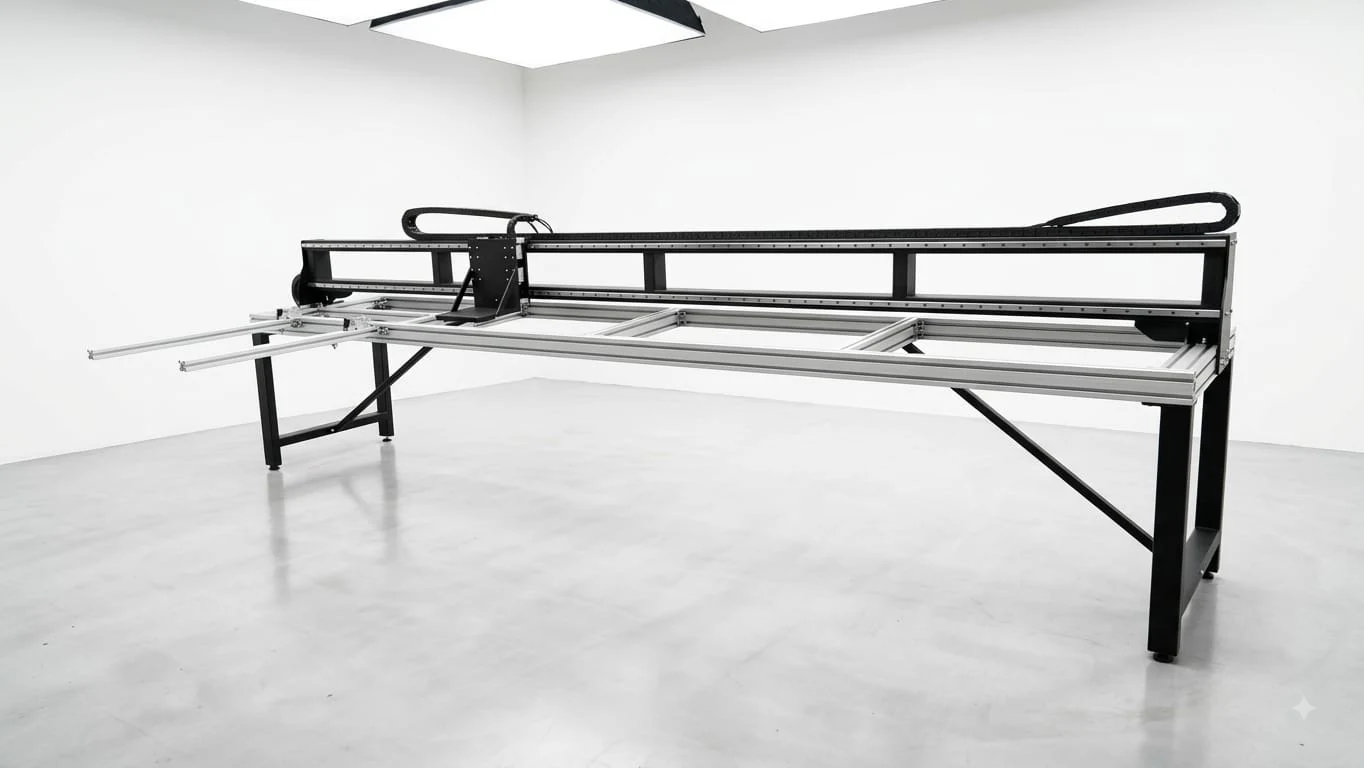
Every shop that works sheet goods has the same first problem: a full sheet is bigger than any bench in the building. It gets cut anyway — on trestles, on the floor, on two saw horses and a sacrificial sheet of insulation — and then somebody has to explain why a cabinet part is two millimetres wider at one end, or why a composite cassette will not sit flat in its frame.
It is almost never the saw. A decent circular saw with a sharp blade cuts a clean, straight line. What it cannot do is hold that line over two and a half metres while the panel underneath it moves.
What actually goes wrong
Three things, in this order of frequency.
1. The panel moves before the cut is finished
On two trestles a sheet is supported in two places and unsupported everywhere else. As the blade passes the middle, the panel sags, and sagging changes the angle between the sole plate and the face. Worse, the offcut starts to drop the moment it is free, so the last foot of the cut closes on the blade. That is where the taper and the burn mark come from.
2. The guide is re-referenced on every cut
A clamped straightedge has to be measured, set, squared and clamped again for every single cut. Each of those four steps carries its own error, and they do not cancel out — they add. Two cuts set from the same tape can easily finish a millimetre apart, and a millimetre shows in a folded corner.
3. The reference edge inherits the last mistake
Most shops square one edge first and then work from it, which is correct. What goes wrong is that after the first rip, the next cut is referenced from a cut edge that inherited whatever error the first cut had. By the fourth part that error has been compounded four times.
The three things that fix it
None of them are exotic, and none of them need a five-figure beam saw.
Support the whole length, not two points
The panel needs a continuous bed, or close to it. On the RailTable 4000 the bed is 740 mm deep and runs the full 157 in (4,000 mm) of the frame: 45 by 90 mm sigma aluminium extrusion carried on a 40 by 60 by 2 mm steel box beam, with 30 by 30 by 2 mm cross members. The sheet sits on that bed for its whole length, so it does not sag in the middle and the offcut does not drop at the end. That one change removes most of the taper before you have touched the saw.
Guide the tool, not the operator
A hand-held saw follows your hands. A saw bolted to a carriage follows a rail. The table carries a 20 mm (0.79 in) profile rail over its full span and two carriages that ride it, each a 5 mm laser-cut steel plate drilled for tool mounting: the circular saw you already own goes on one, a router or groover goes on the other. The cut is then as straight as the rail, and the rail does not get tired at the far end of the sheet.
This is also why there is no motor in the table and not one electronic component. The motor you want is already in your hand, you already know how it sounds when the feed is wrong, and you already own the spares for it. A 220 V supply cable runs in the moving cable duct to feed that tool and keep its lead clear of the panel.
Stop measuring the same length twice
An adjustable mechanical stop runs the full length of the table. You set it once against your first piece and every panel in the run comes off the same, whether that is four pieces or four hundred. There is nothing to read and nothing to calibrate — it is a physical stop, and a physical stop does not drift by half a millimetre because the light was bad.
A working sequence for a full sheet
- Square one edge first. Take a thin cut off one long edge and treat it as the only reference for the whole run. Mark it.
- Cut everything that shares a length in one go. Set the stop once, run the whole batch, then move the stop. Moving the stop is the only place error can enter.
- Rip before you crosscut. A long, narrow part is easier to handle than a short, wide one, and the bed supports the long dimension.
- Let the offcut sit on the bed. Do not catch it. It is already supported, and reaching for it is how the last 8 in of a cut goes wrong.
- Check the diagonals on the first part, not the last. If the first panel is square, the rest of the batch will be too, because nothing has been re-measured since.
What this does not solve
Two things, honestly. The frame is 157 in (4,000 mm) as standard; a 19 ft 8 in (6 m) frame is built to order at a price difference, but if your normal work is longer than that, this is not the machine. And the feed is manual and single-operator — there is no programming, no optimiser and no automatic pusher. A shop cutting a nesting list all day wants a CNC beam saw and should pay for one.
What this table replaces is the trestles, the clamped straightedge, and the ten minutes of hunting for a jig before every batch.
Where to read the numbers
The honest three-way comparison against a track saw and a vertical panel saw, including the two places this table loses, is on the comparison page. Every dimension quoted above, plus the crate and the full packing list, is on the specification page. If you want a delivered figure for your address, the quote form asks for the four things freight actually depends on.


Comments 0
Be the first to comment.