Cutting MDF and Melamine Clean on Both Faces
Melamine chips on the face the blade leaves. Support, scoring, blade and feed, in the order that matters.
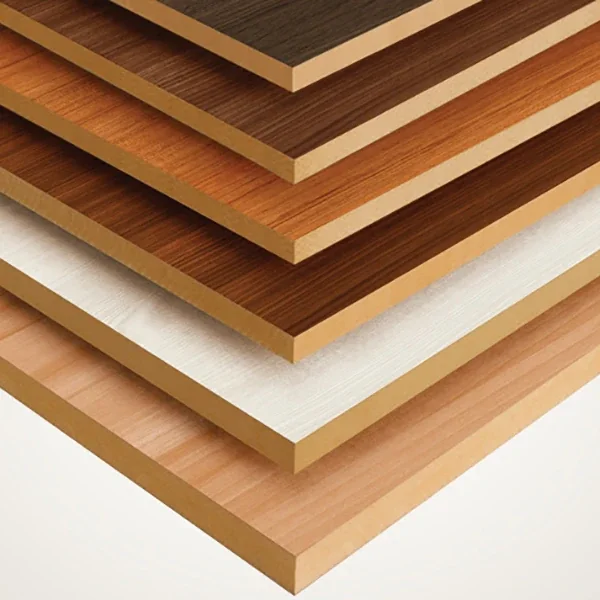
MDF cuts like butter and melamine-faced board does not. The core is the same; the problem is the paper-thin melamine skin, and it fails in one specific place: the face the blade is leaving as it exits the material.
Why it chips where it chips
A circular blade enters the material on one face and exits on the other. On the entry face the teeth press the skin down into the board and it is supported from behind. On the exit face the teeth lift the skin away from the board with nothing behind it, and a brittle 0.1 mm coating lifts in flakes.
Everything below is a way of supporting that exit face.
1. Decide which face matters, and put it down
With a hand-held or carriage-mounted saw cutting from above, the blade exits on the bottom face. So the face the customer will see goes face down. This is the single biggest improvement available and it costs nothing.
On a cabinet part where both faces show, you need a scoring pass — see below.
2. Support the exit face
The board must be sitting on something, not spanning air, or the skin has nowhere to be pressed against. A continuous bed does this by construction. On trestles, a sacrificial sheet under the cut line does it for one job.
This is also why the last part of a cut chips most often: the offcut has started to drop, so the exit face is unsupported exactly where the blade is finishing.
3. Score, then cut
The professional answer for a part that shows on both faces is two passes:
- A shallow pass, about 1 mm deep, along the cut line. This severs the skin in compression while it is still fully supported by the board underneath.
- The full-depth pass along the same line. There is no longer a continuous skin for the exiting teeth to lift.
Two passes along the same line only works if the line is repeatable. On a guided carriage it is: the rail puts the saw in the same place twice. Freehand, the second pass wanders off the first and you get two scores and a chip between them.
4. Blade, and then feed
After support and scoring, blade choice is worth something. High tooth count, a negative or neutral hook, and a triple-chip grind all help on a coated board. A worn blade chips a face that a sharp one would not, and a blade that has been used on chipboard is worn whether it looks it or not.
Feed steadily. Forcing it tears the skin; dwelling in one place burns the core and glazes the edge.
5. Dust, which is not a side issue with MDF
MDF dust is fine enough to hang in the air for hours and it contains the resin that binds the board. Extraction at the saw, a mask that is rated for fine particulate, and a fixed cutting station rather than a different corner of the shop every time — the last one matters more than people expect, because a permanent station is the only kind that gets a permanent extraction run.
Edge banding starts at the cut
Every banding problem you will have was decided before the bander was switched on. Banding sticks to an edge that is square to the face, straight along its length, and clean. It does not stick well to an edge that is slightly out of square, and it shows a shadow line along an edge that bows.
Three things at the saw decide it:
- Square to the face. If the blade is a degree off vertical, the banding is glued to a sloped edge and the glue line is visible on one face.
- Straight along the length. A bowed cut gives a gap in the middle of a long part, which is exactly where somebody runs a thumb.
- No fuzz. A torn MDF edge absorbs glue unevenly. A scored cut does not.
None of these are fixed at the bander. They are all fixed at the cut.
Cutting-list order for a kitchen
A kitchen is the case where order saves the most time, because the same lengths repeat across carcasses that have nothing else in common.
- Rip everything to width first. Sides, tops, bottoms, shelves — get every part to its finished width while the sheets are still full and easy to reference.
- Sort the crosscut list by length, ignoring which cabinet a part belongs to. Twenty-four parts at 720 mm is one stop setting, whether they belong to six cabinets or to one.
- Work longest to shortest. A part cut too short is scrap; a part cut too long can still become a shorter part further down the list.
- Check the first of each setting and no others. If the first is right, the rest are right for the same reason.
- Label as you go. Twenty-four identical parts stop being identifiable the moment they leave the bed.
A working order for a cabinet job
- Square one edge of the sheet and mark it as the datum.
- Sort the cutting list by length; work longest to shortest.
- Good face down.
- Score, then cut, for anything that shows on both faces.
- Set the stop once per length and cut the whole batch.
- Label every part as it comes off the bed.
Where to read the numbers
The bed and rail specification is on the specification page. Why a batch cut against a stop beats a batch measured one part at a time is set out in repeat cuts without measuring, and the honest comparison with a track saw and a vertical panel saw is on the comparison page.

Comments 0
Be the first to comment.