Dust Extraction for a Cutting Table That Does Not Move
A fixed cutting station is the only kind that gets a permanent extraction run. What to put in, and in what order.
Extraction in most small shops is a vacuum on a trolley that follows the work around. It follows the work around because the work has no fixed place. Once the cutting happens in one place every time, a permanent run becomes worth installing — and a permanent run is a different order of capture from a hose somebody remembered to plug in.
What you are capturing, and why it differs by material
- MDF and chipboard: very fine dust carrying the resin that binds the board. This is the one that matters most for health and the one a shop vacuum without a fine filter simply redistributes.
- Composite panel: aluminium swarf and polymer chip. Heavier, less airborne, abrasive — it will wear a plastic hose fitting that wood dust would not.
- Acrylic and foam PVC: light chip with a static charge. It sticks to everything, including the inside of the hose and the face you were protecting.
- Polycarbonate: light, curly, and it will pack a small-diameter hose.
Capture at the tool first
Most of the dust is captured or lost within a few centimetres of the blade. The saw or router you mount on the carriage has a port; connect it. Everything downstream — hose diameter, filter grade, cyclone — only matters for what the port actually collected.
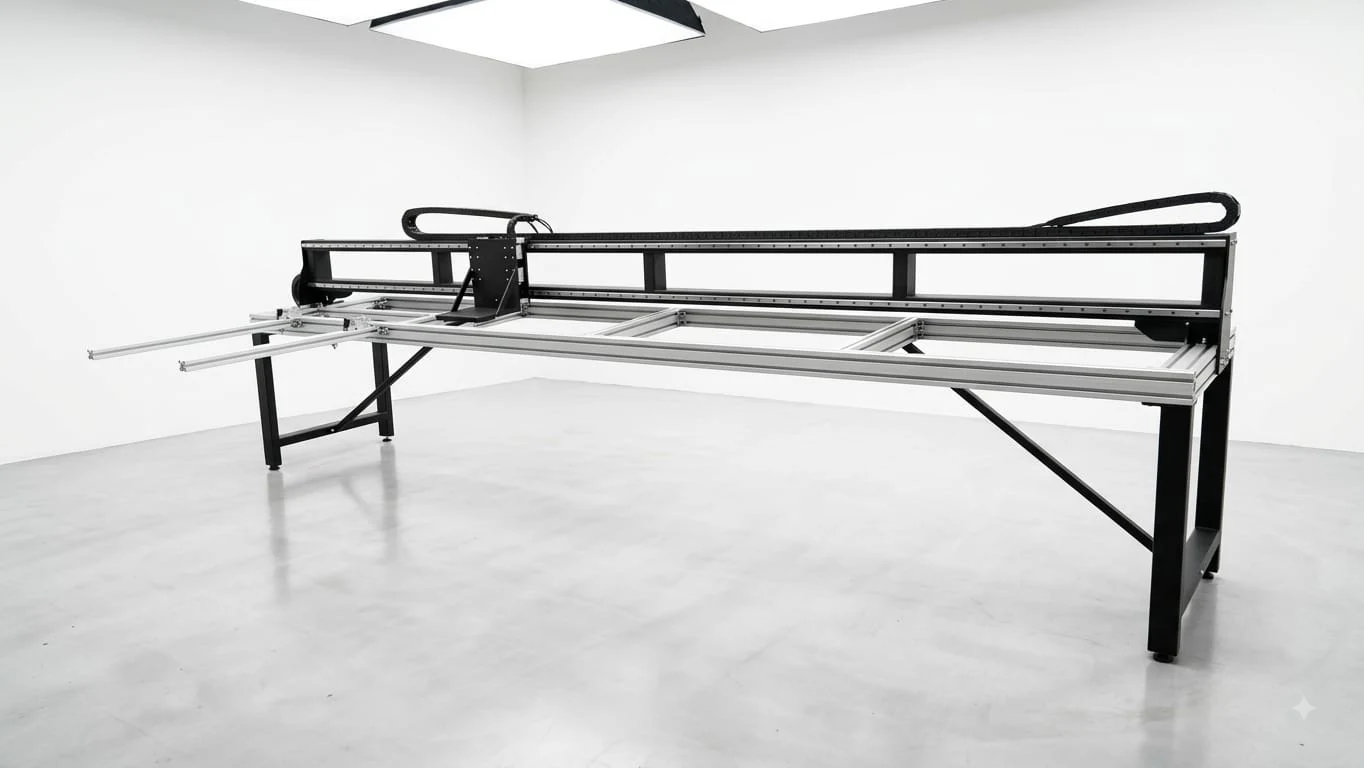
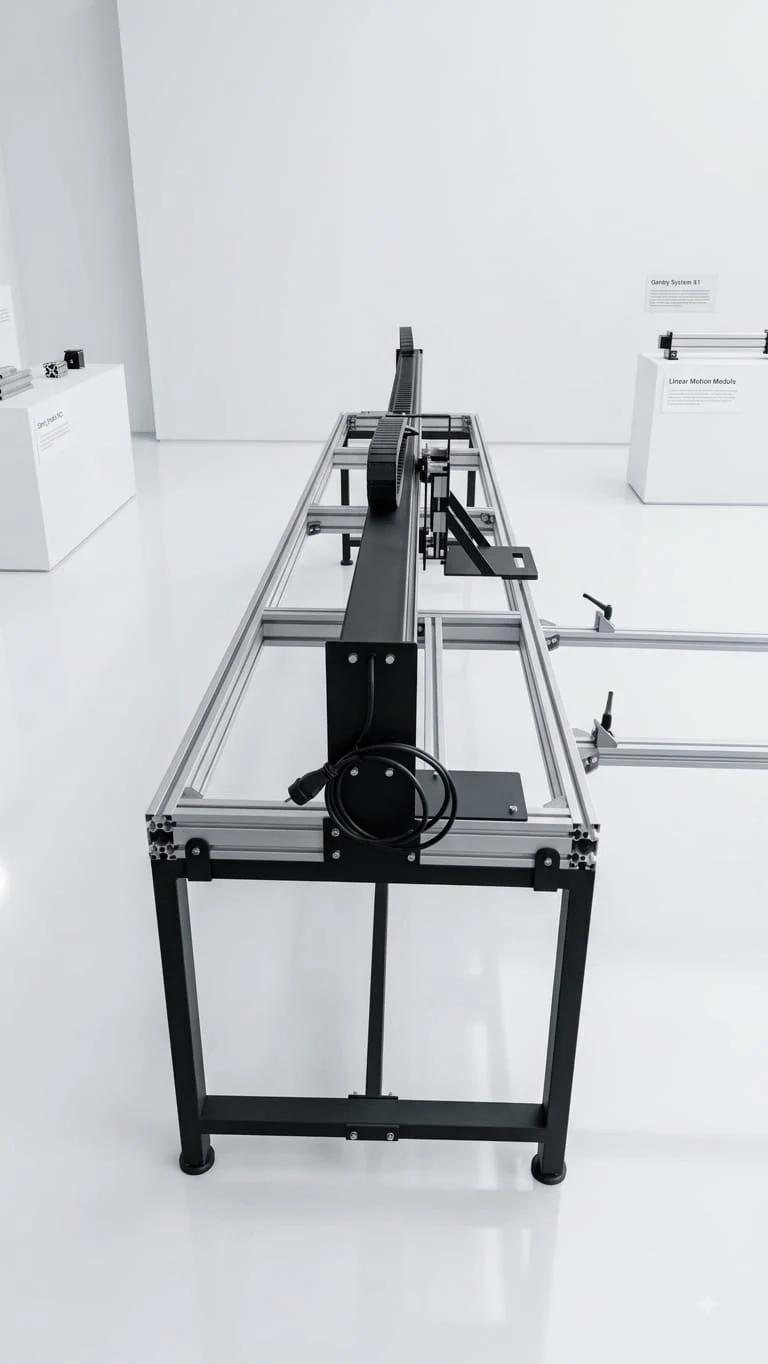
Because the tool travels with the carriage, the hose has to travel with it. That is what the moving cable duct along the beam is for: it carries the tool’s supply lead clear of the panel, and a light extraction hose can run the same way rather than dragging across the sheet you are about to cut.
Then the machine, then the room
- At the tool. The port on the saw or router. Biggest single win.
- Under the bed. The bed is an open frame, so what falls through falls in one place. A tray or a duct under the cutting line collects it instead of the floor.
- The room. An ambient filter deals with what the first two missed — which with MDF is the fraction that stays in the air for hours.
Sizing, in plain terms
A shop vacuum moves a small volume at high suction and suits a tool port. A dust collector moves a large volume at low suction and suits a duct. They are not interchangeable: a collector on a 35 mm tool port will not pull, and a vacuum on a 100 mm duct will not carry. If you want one machine to do both, it is a vacuum at the tool and a separate solution under the bed.
Whatever you use, a fine filter or a cartridge rated for fine particulate is the part that decides whether MDF dust is captured or blown back into the room through a bag.
An order to buy things in
If the budget arrives in pieces, this is the order that gets the most out of each piece.
- A hose and the right adaptor for the tool port. Cheapest item on the list, biggest single improvement, and the one most often missing because the adaptor that came in the box fits nothing.
- A fine filter or a cartridge on whatever you already own. Capturing MDF dust into a bag that passes it straight back into the room is worse than useless, because it feels like extraction.
- A tray or duct under the cutting line. The bed is an open frame; everything that falls through falls in one place, and that place is a known quantity once the station is fixed.
- A cyclone or separator in front of the filter, which stops composite swarf and polycarbonate curls from packing it.
- An ambient filter for the fraction that never reaches any hood.
Three things not to do
- Do not put a dust collector on a 35 mm tool port. It moves volume, not suction; at a small port it will barely pull, and you will conclude extraction does not work.
- Do not run the hose across the panel. It drags on the sheet, catches on the stop, and pulls the tool off line at the worst moment. It travels along the beam with the tool lead.
- Do not blow the bed down with compressed air. It puts every fine particle you had captured back into the room, at head height. Vacuum it.
What the fixed station buys you
- A run of duct that stays connected, so nobody decides not to bother for one quick cut.
- A known place to sweep, rather than a different corner each time.
- Room to put the collector where its noise is not in anybody’s ear.
None of that is possible while the cutting happens wherever the trestles ended up.
Where to read the numbers
The floor run, working height and the rest of what a 13 ft table asks of a shop are in what a cutting table needs from your shop floor. The specification, including the cable duct, is on the specification page.

Comments 0
Be the first to comment.