Repeat Cuts Without Measuring: Why the Stop Matters More Than the Blade
Every measurement in a batch is a chance to be wrong. Why a physical stop beats a good tape.
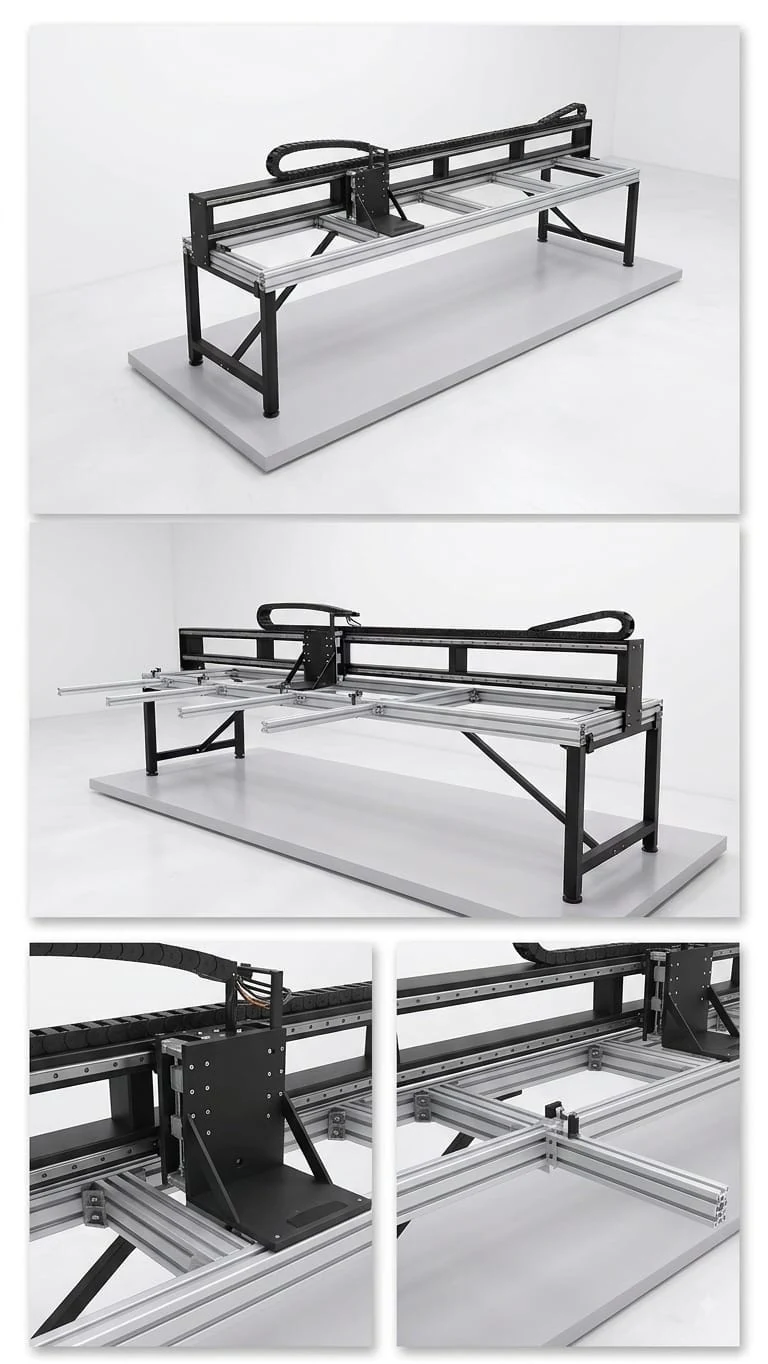
Ask a shop where its time goes on a batch of identical parts and the answer is rarely the cutting. It is the measuring, the marking, the squaring of the guide, and the checking afterwards of the ones that did not come out right.
There is a simple piece of arithmetic underneath that, and it is worth being explicit about.
The arithmetic of measuring twice
Every time you measure a cut, four separate things can go wrong: reading the tape, marking the line, setting the guide to the line, and clamping the guide without it shifting. Call the combined error on a good day half a millimetre.
Now cut forty identical parts, measuring each one. Forty parts, four chances each. The errors are independent, which means they do not cancel — some parts land long, some short, and the spread across the batch is wider than any single error. Then the parts go together, and the tolerances stack.
Set a stop once and cut forty parts against it, and there is exactly one setting operation for the whole batch. Not forty. One. Every part is a copy of the same physical distance, not a fresh interpretation of the same number.
What an adjustable mechanical stop is, and is not
On the RailTable 4000 the stop runs the full length of the table. You slide it to your length, lock it, and push the panel to it. That is the whole mechanism.
It is deliberately not a gauge. There is no scale to read, no digital readout, nothing to calibrate and nothing to lose calibration. That is not a shortcut — it is the point. A readout tells you a number and you still have to trust that the number matches reality. A physical stop is reality: the panel touches it or it does not.
The practical consequence is that you set the stop against your first correct piece rather than against a printed scale. Cut one, check it, and if it is right, everything after it is right for the same reason.
Sequencing a job so the stop barely moves
If the stop is the only place error can enter, the job should be organised so it moves as little as possible.
- Sort the cutting list by length, not by part. Every part that shares a length gets cut together, whichever assembly it belongs to.
- Work from longest to shortest. A part cut too short is scrap; a part cut too long can still become a shorter part. Going down the list keeps every mistake recoverable.
- Cut one, check it, then commit. Check the first piece of each new stop setting and no others. If the first is right the rest are, because nothing changed.
- Label as you go. Forty identical parts stop being identifiable the moment they leave the bed.
Where the rail comes in
A stop fixes the length. It does not fix the line. Those are two different errors and they need two different answers.
The line comes from the 20 mm profile rail that runs the full span of the frame and the carriage that rides it — a drilled 5 mm laser-cut steel plate with your own circular saw bolted to it. The saw travels where the rail goes. Combined with a continuous 740 mm deep bed underneath the panel, the cut stays square for the whole 13 feet instead of wandering as the sheet sags.
Length from the stop, line from the rail, support from the bed. Each of the three failures in a batch job has its own part of the machine answering it.
Where it does not help
A stop is worth nothing on a job where every part is a different length and there is only one of each. That is a one-off, and a one-off is measured no matter what machine it is cut on. The stop earns its keep from the second identical part onward, and it earns a lot of it by the fortieth.
Where to read the numbers
The four moves a job actually takes are set out on the machine page, and the full frame, rail and bed specification is on the specification page. For how this compares with measuring against a clamped rail, see the comparison page.



Comments 0
Be the first to comment.