Track Saw, Vertical Panel Saw or Cutting Table: What Each One Costs You
An honest comparison of the three ways a small shop cuts sheet goods, including where each one loses.
There are three realistic ways a small or mid-sized shop cuts sheet goods without buying a CNC beam saw. Each of them is genuinely the right answer for some shops. This is an attempt to say which, without pretending one of them wins everything.
The track saw
A track saw is a circular saw made to run on its own extruded rail. It is the cheapest of the three by a wide margin, it fits in a van, and on a single cut it is accurate.
What it is good at: site work, one-off cuts, anything that has to happen where the panel already is. If you install as well as fabricate, you want one regardless of what else you own.
What it costs you: the rail is re-clamped for every cut, which means every cut is measured and set again. Beyond roughly 110 in the rail has to be joined, and a joined rail is only as straight as the join. The panel is supported by whatever is underneath it, so the offcut drops. And the saw has to be that manufacturer’s saw — the rail is not a general-purpose fixture.
The vertical panel saw
A vertical panel saw stands the sheet up against a frame and runs a saw head on a fixed gantry. It is the classic small-shop answer and there is a reason it has been around for decades.
What it is good at: floor space, mainly. It occupies a wall rather than a room. Crosscuts are repeatable, and one person can load a sheet without help because gravity does half the work.
What it costs you: it is bolted to a wall, so it does not move and it does not come with you. Capacity is set by the frame — a 97 in machine cuts a 97 in sheet and nothing longer. It has its own dedicated motor, so you are maintaining another machine. And it does not V-groove, which for a sign or cladding shop is not a small omission.
The rail cutting table
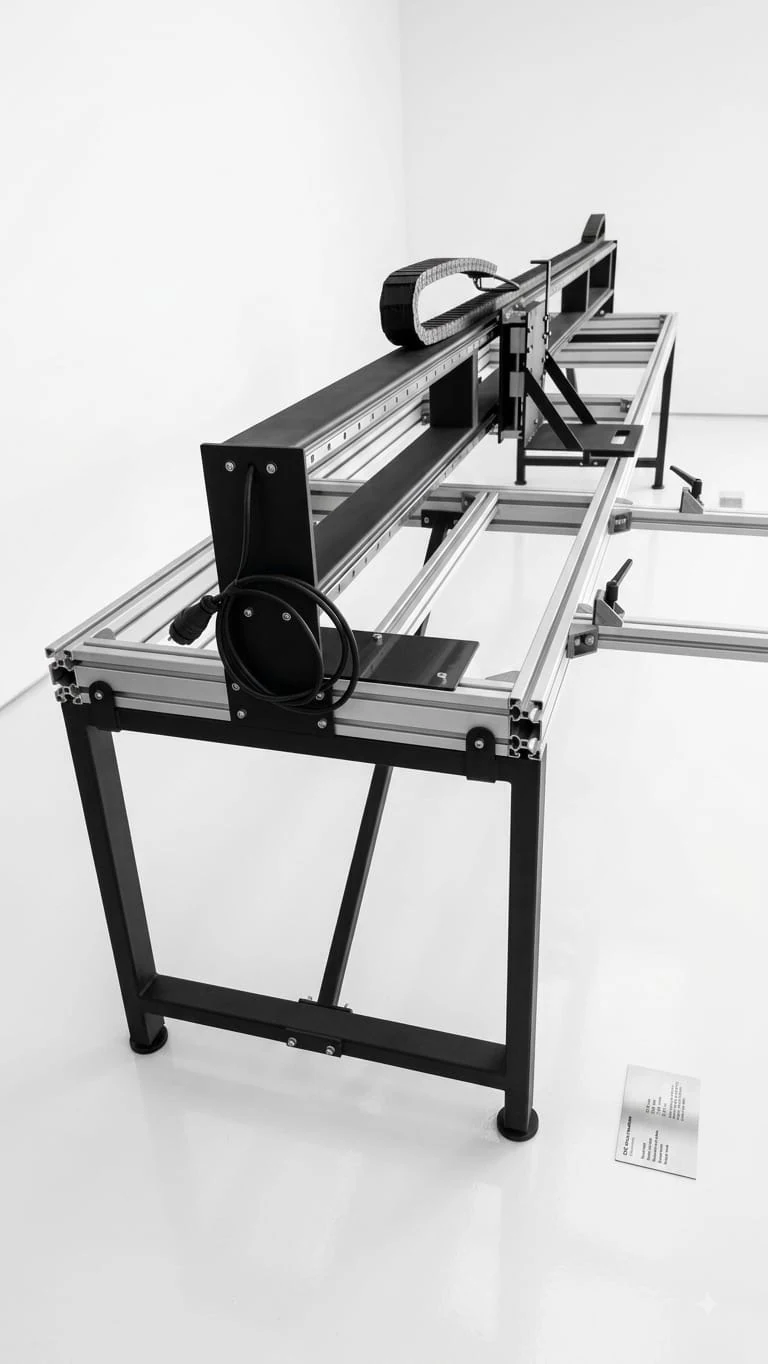
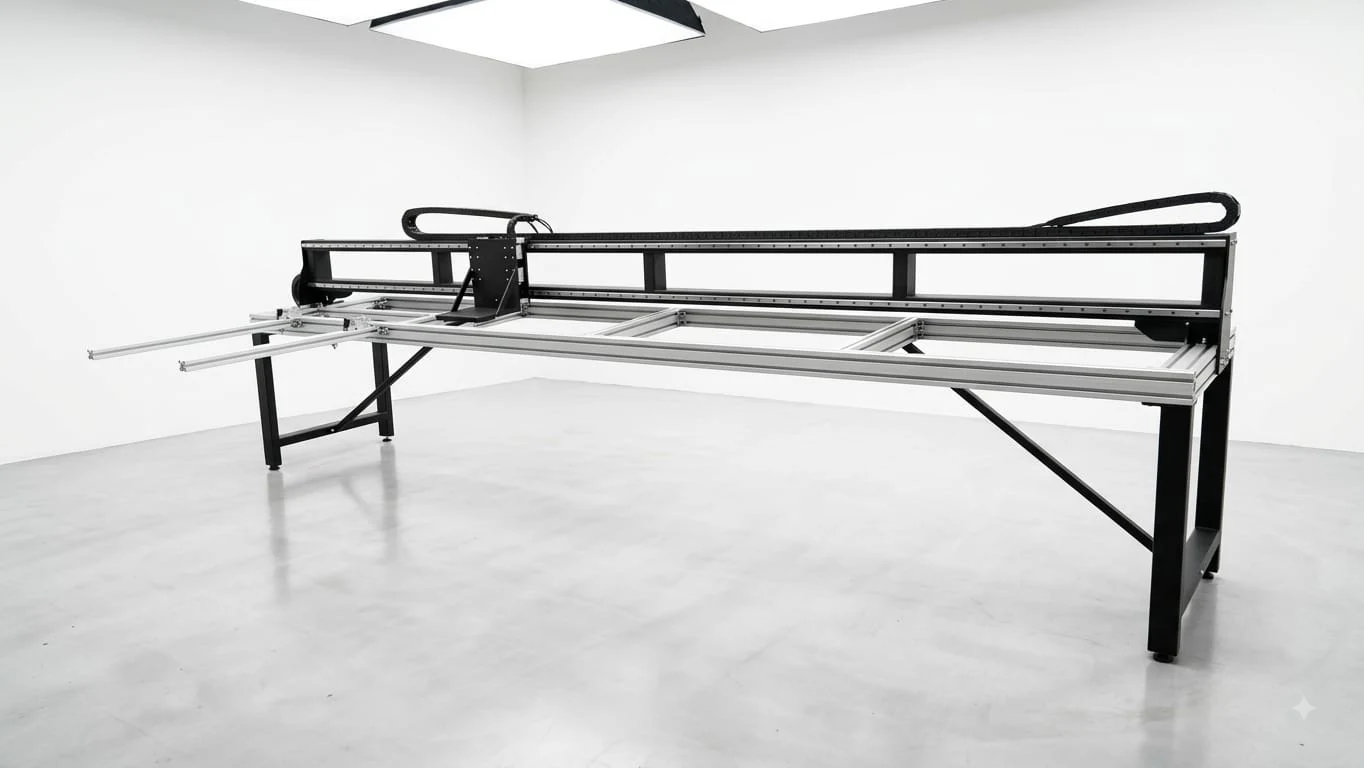
The third option is a horizontal table with a profile rail over its length and carriages that carry tools you already own. That is what the RailTable 4000 is.
What it is good at: length and repeatability on the same machine. The frame is a single-piece 157 in (4,000 mm) weldment — 157 in — with a 20 mm (0.79 in) profile rail over the full span, so a long cut is one continuous pass with no rail join. The panel is supported along its whole length on a 740 mm deep bed, so the offcut does not drop. An adjustable mechanical stop runs the full length, so a batch of identical parts is set once and then just cut. And the second carriage takes a router or groover, which is what makes V-groove and channel work possible on the same bed, in the same setup.
It also runs the tools you already own. The carriages are drilled 5 mm steel plates; you bolt your circular saw to one and your router to the other. There is no motor in the table and no control gear, so there is nothing extra to service.
What it costs you — and this is the honest part:
- Floor space. It is a 13 ft (4 m) table. It needs a 13 ft run of floor plus room to walk one long side. A vertical saw does not.
- Portability. The legs unbolt, but the 13 ft (4 m) frame does not fold. It is not going in a van to a site. A track saw is.
Side by side
| Capability | RailTable 4000 | Track saw + rail | Vertical panel saw |
|---|---|---|---|
| Frame length | 157 in / 13 ft 1 in | rail joins beyond 110 in | 97 in sheet |
| Repeatable length without measuring | Yes — set the stop once | No — measure every cut | Yes |
| V-groove and channel work | Yes — groover carriage | No | No |
| Runs the tools you already own | Yes — drilled tool plates | Rail-specific saw only | No — dedicated motor |
| Jigs or templates needed | None | Rail re-clamped each cut | None |
| Panel supported along its whole length | Yes | No — the offcut drops | Partially |
| Moves between shops | Legs unbolt, the 13 ft (4 m) frame does not | Yes — fits a van | No — fixed to a wall |
How to choose in one paragraph
If most of your cutting happens on site, buy a track saw and stop reading. If your shop has no floor to spare and you never groove anything, a vertical panel saw is a sound machine and always has been. If you cut long sheet goods in batches, fold composite or foam PVC, and the thing costing you time is setting up rather than cutting — that is the case a cutting table is built for.
Where to read the numbers
The full specification, the crate size and the packing list are on the specification page, and the machine page walks through the four moves a job actually takes. For a delivered figure to your address, the quote form asks for the four things freight depends on.

Comments 0
Be the first to comment.